The possibilities for advancing theoretical physics through experimentation are remarkably rare, so an event of this magnitude should be followed with interest. Whatever the results, physics is about to undergo a huge leap forward.
As long as we are still around to see it... {Joke}
However, I have a question regarding the nature of Time&Space that seems to have been ignored, as it is most difficult to find an answer. Either that or I am being an idiot... :->
What Happens to Time when there is no matter?
We understand that the presence of Energy/Matter causes gravity and the curvature of SpaceTime. In fact with enough energy/matter density we get a gravity well of such density that it is effectively infinite, i.e.: a black hole.
It should also be noted that gravity and time are linked. As gravity becomes bigger, time dilates and each period of time lengthens.
Until we reach the theoretical point: that a person (who survived) falling into the event horizon of a black hole would experience such extreme time dilation that they would be able to watch the end of the universe.
This seems to be the normal point of interest, and everyone stops there.
However, my question relates to the opposite.
The opposite of everything?
Before the Big Bang, when there was no matter or energy, there was nothing to curve SpaceTime.
What happens to time in this situation?
What is the shape of the curve?
As far as I can see there are two probably answers.
1. It is a simple curve, and time tends towards a fixed point
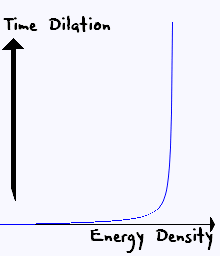
2. It is a TAN like curve, where time tends towards infinite values.

For some reason I rather like the 2nd answer, but I have been unable to find anything that would suggest this is the case.
It is an interesting theory, as given my assumption that Curve2 is correct: then all time before the Big Bang, i.e.: before the existence of energy/matter, would be contracted into an infinitely short period. At least from a theoretical observers point of view.
In effect the opposite of a a back hole, the opposite of a gravitational singularity with time dilation.
So my question is:
In the TOTAL absence of energy/matter, does time becomes a singularity.
Request for comment
I have been looking for an answer to this question for a few years. Can you help? Do you know anyone who has already considered or answered this?
Please let me know.
